
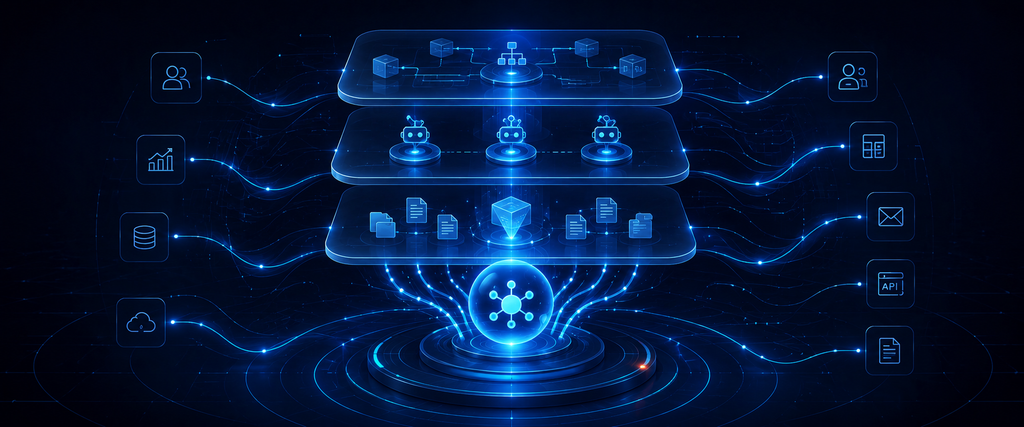
Intelligent Automation in 2026: The Complete Guide to RPA, AI Agents & Hyperautomation
 Technodict11 min read
- Intelligent Automation
- Business Process Automation
- RPA
- Hyperautomation
- AI Agents
- Workflow Automation
- Finance Automation
- Agentic Automation
Introduction
For a decade, "automation" mostly meant recording a human's clicks and replaying them. That era is ending. Generative and agentic AI have turned software bots from scripted actors into systems that can reason, plan, and act across applications. The result is both an enormous opportunity and a new failure mode: organizations that treated automation as a tooling purchase are discovering that autonomy without governance is expensive and fragile.
This is the central tension of 2026. The upside is real — measurable cost reduction, faster cycle times, and staff freed from repetitive work. The downside is equally real — pilots that dazzle in a demo and then quietly die before they ever scale. The difference between the two outcomes is rarely the technology. It is strategy, sequencing, and engineering discipline. This guide gives you all three, in a vendor-neutral way, so you can decide what fits your organization rather than what fits a sales pitch.
Table of Contents
- What Is Intelligent Automation?
- The Four Layers: Workflow, RPA, IPA, and Agentic Automation
- BPA vs RPA vs Workflow Automation vs AI Agents
- The Hyperautomation Stack in 2026
- Which Processes Should You Automate First?
- Implementation Guide: From Pilot to Production
- Why Automation Projects Fail — and How to Avoid It
- Measuring Automation ROI Beyond Cost Savings
- Industry Use Cases
- Automation Trends Shaping 2026
- Conclusion
What Is Intelligent Automation? {#what-is-intelligent-automation}
Intelligent automation is the combination of process automation with artificial intelligence so that software can handle not only structured, rule-based tasks but also unstructured input and judgment-based decisions. Where classic automation needs perfectly predictable inputs, intelligent automation reads a scanned invoice, interprets a customer email, or decides which exception path to follow.
It sits on a foundation of ordinary process automation and adds three capabilities: perception (reading documents, images, and language through models built with services like AI and machine learning development), reasoning (choosing among options), and orchestration (coordinating many steps across many systems). When those capabilities are wired into an end-to-end program rather than a single task, the industry calls it hyperautomation.
The Four Layers: Workflow, RPA, IPA, and Agentic Automation {#the-four-layers}
It helps to think of automation as four layers that build on one another rather than as competing products.
Workflow automation routes tasks, approvals, and notifications between people and apps based on rules — a form submission triggers a review, which triggers a handoff. It is the connective tissue of digital operations.
Robotic Process Automation (RPA) uses software bots to mimic human actions at the user-interface level. RPA shines where systems have no API and a human would otherwise copy data from one screen to another — the classic "swivel-chair" work.
Intelligent Process Automation (IPA) adds AI to RPA. Instead of failing on a non-standard invoice, an IPA pipeline uses intelligent document processing to extract the fields, then hands structured data to a bot. This is where most enterprise value has moved.
Agentic automation is the newest layer. Here, an AI agent is given a goal, not a script. It plans the steps, calls tools (including RPA bots and APIs), and adapts when something changes. Agents are powerful precisely because they are non-deterministic — and risky for the same reason, which is why governance matters more at this layer than any other.
BPA vs RPA vs Workflow Automation vs AI Agents {#bpa-vs-rpa}
One of the most common searches in this space is simply "what's the difference?" Here is a compact comparison. For a deeper treatment, see our dedicated post on BPA vs RPA vs workflow automation.
| Dimension | Workflow Automation | RPA | Intelligent / Business Process Automation | AI Agents |
|---|---|---|---|---|
| What it automates | Task routing & approvals | UI-level repetitive actions | End-to-end processes with unstructured input | Goal-driven multi-step work |
| Handles unstructured data? | No | Limited | Yes (via AI) | Yes |
| Decision-making | Rules only | Rules only | Rules + ML | Reasoning + planning |
| Integration style | App connectors/APIs | Screen scraping / UI | Mixed (API + UI + AI) | Tools, APIs, and other bots |
| Best for | Handoffs, notifications | Legacy systems without APIs | Documents, claims, exceptions | Dynamic, variable processes |
| Main risk | Rigidity | Brittleness on UI change | Model accuracy | Autonomy without control |
The practical takeaway: these are complementary, not mutually exclusive. RPA is not "replaced" by AI agents; in most mature architectures, an agent calls a bot as one of its tools. Choosing well means matching the layer to the process, not chasing the newest label.
The Hyperautomation Stack in 2026 {#the-hyperautomation-stack}
Hyperautomation is the discipline of orchestrating multiple automation technologies to automate as many business and IT processes as possible — and to keep improving them. A modern stack has five tiers:
- Discovery — process mining and task mining find where work actually flows and where the friction is. Our process mining solutions turn event logs into an automation backlog instead of guesswork.
- Automation — RPA bots and workflow engines execute the repetitive steps.
- Intelligence — AI models handle documents, language, and predictions, often built in Python and deployed through robust ML pipelines.
- Orchestration — an agent or orchestration layer coordinates bots, APIs, humans, and models across the end-to-end process.
- Governance & Operations — monitoring, security, and controls keep the digital workforce healthy, observable, and compliant.
The teams that win in 2026 are not the ones with the most bots. They are the ones who treat this stack as a product — versioned, tested, and operated with the same DevOps discipline they apply to software.
Which Processes Should You Automate First? {#which-processes-first}
The single biggest predictor of automation success is choosing the right first processes. A simple prioritization scores each candidate on two axes: value (volume × time saved × error/compliance cost) and feasibility (stability of the process, availability of structured data, number of systems involved).
Prioritize processes that are:
- High volume and repetitive — the same steps, many times a day.
- Rule-based or lightly judgmental — decisions can be codified or modeled.
- Stable — the underlying screens and rules do not change weekly.
- Painful today — slow, error-prone, or compliance-sensitive.
Deprioritize processes that change constantly, depend on unstructured human judgment with no data trail, or touch systems slated for replacement. A short automation prioritization and governance guide can turn this into a repeatable scoring workshop for your team.
Implementation Guide: From Pilot to Production {#implementation-guide}
Most automation value is lost in the gap between a working pilot and a scaled program. Only about 3% of organizations have successfully scaled their digital workforce, and 63% report that implementation took longer than expected. This step-by-step path is designed to close that gap.
- Discover and prioritize. Use process mining and a scoring workshop to pick two or three high-value, high-feasibility processes.
- Design for exceptions first. Map the unhappy paths, not just the happy one. Brittle bots fail on the exceptions nobody documented.
- Build a thin end-to-end slice. Automate one process fully — including error handling and human-in-the-loop escalation — before automating many partially.
- Instrument everything. Log every bot action and decision so you can debug and prove ROI later.
- Establish governance early. Define who owns bots, how credentials are managed, and how changes are reviewed. Autonomy needs a control plane.
- Operate like software. Version automations, test them in CI, and monitor them in production — the same practices our intelligent automation consulting team brings to enterprise rollouts.
- Scale by templating. Turn your first wins into reusable components so the next process takes weeks, not quarters.
A Note on Code and APIs
Where systems expose APIs, prefer them over screen-scraping RPA — API-based automation is far more stable. A minimal example of an idempotent automation task in Python might look like:
def process_invoice(invoice):
    if invoice.status == "processed":
        return invoice  # idempotent: safe to retry
    data = extract_fields(invoice.document)   # AI document understanding
    if data.confidence < 0.85:
        return escalate_to_human(invoice, data)  # human-in-the-loop
    post_to_erp(data)                          # API call, not screen scraping
    invoice.status = "processed"
    return invoice
Design principles matter more than the language: idempotency, confidence thresholds, and explicit human escalation are what keep automations reliable at scale.
Why Automation Projects Fail — and How to Avoid It {#why-projects-fail}
Gartner's prediction that more than 40% of agentic AI projects will be canceled by the end of 2027 is not an indictment of the technology; it is a description of poorly scoped projects. The recurring failure modes are consistent:
- Escalating cost — complexity revealed only during implementation. About 37% of RPA adopters report higher-than-expected costs.
- Unclear business value — measuring the wrong metric (cost only) instead of productivity, cycle time, and revenue velocity.
- Weak controls — hallucinations and unexplainable decisions block production deployment of AI agents.
- Integration failure — non-deterministic agents bolted onto deterministic legacy systems.
- "Agent washing" — vendors rebranding chatbots and RPA as autonomous agents, so buyers invest in capabilities that do not exist.
The antidote is the discipline in the implementation guide above: scope tightly, govern early, instrument everything, and measure the right things. Constrained deployments in IT operations, finance, and support consistently achieve measurable ROI precisely because they are bounded and observable.
Measuring Automation ROI Beyond Cost Savings {#measuring-roi}
If you measure automation only by headcount reduction, you will both understate its value and pick the wrong projects. A fuller model counts four returns:
- Cost — labor and error-correction costs removed. Around 61% of RPA adopters report successful cost reductions, with pilots paying back in roughly 9 months and scaled programs in about 12 months.
- Speed — cycle-time reduction (e.g., claims settled in hours, not days).
- Quality — fewer errors, better compliance, cleaner audit trails.
- Capacity — human hours redirected to higher-value work and revenue growth.
Track these from day one via the instrumentation you built in the implementation phase. Our companion guide on measuring automation ROI walks through a worked calculation.
Industry Use Cases {#industry-use-cases}
Automation value is concrete and vertical-specific:
- Healthcare: revenue-cycle automation, prior-auth processing, and claims — reducing days-in-AR and manual keying.
- Banking and finance: reconciliation, KYC/AML document checks, and back-office straight-through processing.
- Retail: order management, returns processing, and supplier onboarding.
In manufacturing and life sciences, automation-supported sourcing has been linked to procurement savings of 4–12%, with one life-sciences example citing roughly US$19 million (about 5%) in direct material savings. For a deeper, named example, see our automation case studies.
Automation Trends Shaping 2026 {#trends-2026}
Several shifts define the year ahead. Agentic orchestration is moving from pilot to production, with bots becoming one tool an agent can call. Process intelligence first is now standard practice — you mine before you automate. Low-code and citizen developers are expanding who can build, while IT shifts to governing a platform. LLM-based document understanding is collapsing the old OCR-plus-rules pipeline. And governance and observability are becoming the true competitive differentiator: the winners are not the fastest to deploy autonomy but the ones who can deploy it safely. For teams running ERP back-office processes, embedding automation directly into platforms like Frappe/ERPNext keeps the logic close to the data it acts on.
Conclusion {#conclusion}
Intelligent automation in 2026 rewards architecture over enthusiasm. The technology — workflow automation, RPA, intelligent document processing, and AI agents — is more capable than ever, but capability is not the constraint. Sequencing, governance, and measurement are. Organizations that pick the right processes, build thin end-to-end slices, instrument everything, and measure the full return will capture the double-digit growth the market promises. Organizations that chase labels and skip governance will help fill Gartner's 40% cancellation statistic. The path to the right side of that line is not more tools; it is more discipline — and a partner who has walked it before.
Key Takeaways
- Automation in 2026 is a stack — workflow, RPA, IPA, and AI agents — not a single product; the layers are complementary.
- Hyperautomation orchestrates that stack and continuously improves it; discovery (process mining) comes before automation.
- The biggest success factor is choosing the right first processes: high-value and high-feasibility.
- Most value is lost between pilot and scale — only ~3% of organizations scale their digital workforce successfully.
- Gartner predicts 40%+ of agentic AI projects will be canceled by 2027; governance, scoping, and measurement are the antidote.
- Measure ROI across cost, speed, quality, and capacity, not cost alone.
References
- MarketsandMarkets — Business Process Automation Market. https://www.marketsandmarkets.com/Market-Reports/business-process-automation-market-151902976.html
- Technavio — Business Process Automation Market Analysis. https://www.technavio.com/report/business-process-automation-market-analysis
- GlobeNewswire (Precedence Research) — RPA Market Size 2026→2035. https://www.globenewswire.com/news-release/2025/12/16/3206126/0/en/Robotic-Process-Automation-RPA-Market-Size-Expands-from-USD-35-27-Bn-in-2026-to-USD-247-34-Bn-by-2035.html
- Fortune Business Insights — RPA Market to hit $72.64B by 2032. https://www.fortunebusinessinsights.com/press-release/robotic-process-automation-rpa-market-9551
- Market.us — Robotic Process Automation Statistics. https://scoop.market.us/robotic-process-automation-statistics/
- Gartner (via byteiota) — 40% of agentic AI projects canceled by 2027. https://byteiota.com/gartner-40-agentic-ai-projects-fail-heres-why/
- Gartner (via AI Business) — 30% of generative AI initiatives abandoned by 2025. https://aibusiness.com/automation/gartner-predicts-30-of-generative-ai-initiatives-will-fail-by-2025
- SS&C Blue Prism — Future of RPA: Trends & Predictions. https://www.blueprism.com/resources/blog/future-of-rpa-trends-predictions/
- ThinkAutomation — BPA vs RPA vs Workflow Automation. https://www.thinkautomation.com/blog/bpa-rpa-workflow-automation-difference
- Gartner — 10 Automation Mistakes to Avoid. https://www.gartner.com/en/articles/10-automation-mistakes-to-avoid
Frequently Asked Questions
Intelligent automation combines process automation (like RPA and workflow tools) with artificial intelligence so software can handle both structured, rule-based tasks and unstructured inputs or decisions — such as reading a document or interpreting an email.
RPA automates specific UI-level tasks by mimicking human clicks, often on legacy systems without APIs. BPA is broader — it automates entire end-to-end processes across systems and may use RPA, workflow engines, and AI together.
Hyperautomation is the disciplined orchestration of multiple automation technologies — process mining, RPA, AI, low-code, and orchestration — to automate and continuously improve as many processes as possible, rather than a single task.
No. In most mature architectures, AI agents use RPA bots as one of their tools. Agents add reasoning and planning; bots remain a reliable execution layer for systems without APIs.
Start with processes that are high-volume, repetitive, rule-based, stable, and painful today. Deprioritize processes that change constantly or rely on undocumented human judgment.
Common causes are escalating cost, unclear business value, weak governance and controls, integration problems with legacy systems, and "agent washing." Gartner predicts more than 40% of agentic AI projects will be canceled by the end of 2027 for these reasons.
Measure four returns, not just cost: cost removed, cycle-time reduction, quality and compliance improvements, and human capacity redirected to higher-value work. Instrument automations from day one so you can prove the numbers.
Costs vary widely by scope, but RPA pilots often pay back in about 9 months and scaled programs in about 12 months. Roughly 37% of adopters report costs higher than expected, which is why tight scoping and governance matter.
Ready to Automate the right processes — and actually scale them?
TechnoDict's Automation practice helps you mine your processes, prioritize the highest-value candidates, and ship governed, production-grade automations that hold up in the real world.
Related reading

AI Agents vs Traditional Automation: What Enterprises Should Adopt in 2026
Enterprises no longer ask "should we automate" — they ask "with what." Robotic process automation (RPA) built the last decade of back-office efficiency. AI agents are now promising to handle what RPA never could: judgment, exceptions, and unstructured work. But the two aren't interchangeable, and 2026 is the year most enterprises will have to decide, process by process, which paradigm belongs where — or how to run both together. This guide breaks down the real differences, where each wins, where they fail, and how to build a hybrid roadmap instead of betting the whole automation budget on hype.
Technodict10 min read- Agentic AI
- RPA
- Intelligent Automation
- AI Agents

OpenMontage + ComfyUI: Building a Self-Hosted AI Video Production Pipeline in 2026
Generative video models produce clips, not finished videos — the other 85% is orchestration. This guide shows how to connect OpenMontage's agentic production pipeline to a self-hosted ComfyUI backend: the adapter architecture, continuity engineering, VRAM realities, quality gates, and where self-hosting actually beats a commercial API.
Technodict17 min read- Intelligent Automation
- MLOps
- AI Agents
- Generative AI