

AI Agents vs Traditional Automation: What Enterprises Should Adopt in 2026
 Technodict10 min read
- AI Agents
- RPA
- Intelligent Automation
- Agentic AI
Walk into almost any enterprise automation planning meeting in 2026 and you'll hear the same tension: the RPA team wants to keep scaling what already works, and the AI team wants budget for agents that promise to handle the messy, judgment-heavy work bots can't touch. Both are right about their own strengths — and both tend to oversell them.
Traditional automation, mainly RPA, is deterministic. It follows exact, pre-programmed steps against a defined interface or API. It's fast, cheap to run at scale, auditable, and completely predictable — as long as nothing changes. AI agents are different in kind, not just degree: they use large language models to plan, reason, call tools, and adapt their approach based on context, without every step being hard-coded in advance.
This guide gives enterprise decision-makers a clear-eyed comparison, a practical framework for choosing between them, and a realistic picture of where the two combine — because for most organizations, the honest answer in 2026 isn't "agents" or "automation." It's both, applied deliberately.
Table of Contents
- What Traditional Automation Actually Is
- What an AI Agent Actually Is
- The Core Differences, Side by Side
- Where Traditional Automation Still Wins
- Where AI Agents Are Worth the Investment
- Cost and ROI: What Actually Changes
- Governance, Risk, and Compliance
- The Hybrid Model: Hyperautomation in Practice
- A Decision Framework for 2026
- Common Mistakes Enterprises Make
- Implementation Roadmap
- Future Trends
What Traditional Automation Actually Is
Traditional automation — RPA, workflow automation, and rule-based scripting — executes a fixed sequence of steps against a known interface. A bot logs into a system, extracts a value, moves it to another system, and triggers the next step. It doesn't "understand" the task; it replays it. That's precisely why it's so reliable: given the same input, it produces the same output, every time, with a full audit trail. TechnoDict's automation and RPA services are built on this same principle — deterministic, testable, and predictable at scale.
Where it lives today: invoice processing, data entry between legacy systems, scheduled report generation, form validation, and any high-volume, low-ambiguity task where the process itself rarely changes.
What an AI Agent Actually Is
An AI agent is not a smarter chatbot. It's a system built on a large language model that can plan a sequence of actions, call tools or APIs, evaluate the result, and adjust — often without a human specifying every step in advance. The defining trait is autonomy over how to reach a goal, not just execution of a fixed script.
This is the layer TechnoDict's [AI and machine learning development team] increasingly builds for enterprise clients: agents that read unstructured documents, reason about intent, decide which system to update, and handle exceptions a rule-based bot would simply fail on.
Where it lives today: customer support triage that requires judgment, research and synthesis tasks, dynamic scheduling with multiple constraints, and workflows where the "correct" next step genuinely depends on context.
The Core Differences, Side by Side
| Dimension | Traditional Automation (RPA) | AI Agents |
|---|---|---|
| Logic | Rule-based, pre-scripted | Reasoning-based, LLM-driven |
| Handles ambiguity | No — fails or errors out | Yes — interprets and adapts |
| Predictability | Fully deterministic | Probabilistic, can vary |
| Auditability | High — every step logged | Requires added observability tooling |
| Setup effort | Process mapping + scripting | Prompt/tool design + guardrails |
| Cost model | Per-bot licensing, predictable | Per-token/inference, usage-based |
| Best for | High-volume, stable, rule-based tasks | Judgment-heavy, variable, unstructured tasks |
| Failure mode | Breaks visibly on UI/process change | Can "succeed" incorrectly, silently |
| Regulatory comfort | High, well-understood | Still maturing, needs governance layer |
Where Traditional Automation Still Wins
Despite the hype cycle, RPA is not obsolete in 2026, and enterprises that assume otherwise waste money re-building things that already work. Traditional automation wins whenever:
- The process is high-volume and repetitive with almost no variation.
- Full auditability is a regulatory requirement (finance, insurance, healthcare claims processing).
- The cost of an incorrect autonomous decision is unacceptable and the task is simple enough not to need judgment.
- The system integrates with legacy interfaces that don't expose clean APIs for an agent to reason over.
This is exactly why TechnoDict's [industries practice in banking and financial services] still leans heavily on RPA for reconciliation, KYC document processing, and regulatory reporting — the ambiguity that would justify an agent simply isn't present in these workflows.
Where AI Agents Are Worth the Investment
AI agents earn their cost premium when the task genuinely requires judgment, not just speed. That includes:
- Unstructured data interpretation — reading a contract, an email thread, or a medical note and deciding what it means.
- Dynamic, multi-step workflows where the next action depends on what was just discovered, not a fixed flowchart.
- Cross-system orchestration where an agent has to decide which system to touch, not just execute a pre-mapped integration.
- Customer-facing interactions where tone, context, and partial information matter.
TechnoDict has seen this play out directly in retail deployments, where agents handling customer inquiries resolve context-heavy questions (order status plus a policy exception plus a refund judgment) that would have required three separate rule-based bots and a human escalation under the old model.
Cost and ROI: What Actually Changes
The economics are genuinely different, not just the technology:
- RPA cost is largely fixed and predictable: licensing per bot, plus maintenance when the underlying UI changes.
- Agent cost scales with usage — inference/token cost per task — which means it's cheap for low-volume, high-value decisions and can get expensive fast at the volumes RPA was built for.
- RPA generally offers more predictable operating costs, while agentic systems introduce usage-dependent inference and orchestration costs.
The practical implication: don't put an agent on a task that runs 50,000 times a day if an existing RPA workflow already performs the task reliably at a low per-transaction cost. Reserve agent spend for the smaller number of tasks where judgment saves real cost or prevents real error — a few hundred complex customer escalations a day, not every transaction.
Governance, Risk, and Compliance
This is where most enterprise agent projects stall, and it deserves to be treated as a first-class requirement, not an afterthought.
- Audit trail: RPA logs every step by default. Agents need explicit observability tooling layered on top — logging not just the outcome but the reasoning path.
- Human-in-the-loop checkpoints: high-stakes decisions (approving a payout, denying a claim) should route through human review even when an agent could technically complete them end-to-end.
- Model and data risk: agents can be manipulated by adversarial inputs (prompt injection) in ways a rule-based bot simply cannot.
- Regulatory posture: regulated industries should expect scrutiny of autonomous decision-making; document the guardrails before deployment, not after an incident.
TechnoDict build exactly this kind of observability and guardrail layer for clients moving agents into production — logging, rollback, and human-review gates included by default rather than bolted on later.
The Hybrid Model: Hyperautomation in Practice
The real 2026 story isn't RPA versus AI agents — it's RPA plus AI agents, orchestrated together. This is the hyperautomation model TechnoDict covered in its earlier guide, Intelligent Automation in 2026: The Complete Guide to RPA, AI Agents & Hyperautomation: deterministic bots handle the high-volume, stable core of a process, and an agent sits at the exception points — the 10–15% of cases where the rules break down and judgment is required.
A common pattern: an RPA bot processes an invoice normally, but when it hits a mismatch or an unfamiliar vendor format, it hands off to an agent that reads the document, resolves the ambiguity, and either completes the task or escalates to a human — logging its reasoning the whole way.
A Decision Framework for 2026
Ask these questions per process, not per department:
- Does the task require judgment, or just execution? Execution → RPA. Judgment → agent.
- How often does the process change? Stable → RPA. Frequently changing inputs/formats → agent.
- What's the volume? Very high volume, low complexity → RPA for cost reasons. Lower volume, high complexity → agent is worth the premium.
- What's the cost of a wrong autonomous decision? High and hard to reverse → keep a human in the loop regardless of which tool executes it.
- Do you have governance tooling in place? If not, that's a prerequisite investment before agent deployment, not a parallel track.
Common Mistakes Enterprises Make
- Replacing working RPA bots with agents purely because agents are newer — adding cost and non-determinism with no judgment requirement to justify it.
- Deploying agents into regulated, high-stakes decisions without an audit trail or human checkpoint.
- Assuming agent accuracy will match RPA's determinism — it won't, by design, and the business case should account for that variance.
- Treating this as an either/or budget decision instead of a per-process routing decision.
Implementation Roadmap
- Inventory current automation — map existing RPA processes and their failure/exception rates.
- Identify exception-heavy processes — these are the strongest early candidates for an agent layer.
- Pilot one agent use case with clear guardrails — human-in-the-loop by default, full logging, a defined rollback path.
- Measure against RPA's baseline — cost per task, accuracy, and time saved, not just "it works."
- Scale deliberately — expand agent scope only where the pilot proves both accuracy and governance hold up.
TechnoDict's automation case studies walk through exactly this staged approach with real client outcomes.
Future Trends
Expect multi-agent orchestration (agents coordinating other agents) to move from experimental to standard practice for complex workflows, alongside emerging agent-to-agent communication standards that let specialized agents hand off work the way microservices call each other today. Expect governance and observability tooling for agents to become a baseline purchasing requirement rather than a differentiator, and expect RPA vendors to keep absorbing agentic features rather than being displaced outright — the distinction between "RPA platform" and "agent platform" will keep blurring through 2027–2028. TechnoDict's broader AI strategy guide covers where this trajectory fits into a full enterprise AI roadmap.
Conclusion
The choice between AI agents and traditional automation isn't ideological — it's operational. RPA remains the right tool for high-volume, stable, rule-based work where predictability and auditability matter most. AI agents earn their place wherever judgment, ambiguity, and unstructured context make a fixed script unworkable. The enterprises that get the most value in 2026 won't be the ones that pick a side — they'll be the ones that route each process to the right paradigm, govern the agent layer properly, and treat hyperautomation as the actual end state.
Key Takeaways
- RPA and AI agents solve different problems: execution vs. judgment.
- RPA remains the right choice for high-volume, stable, rule-based processes.
- AI agents earn their cost premium on ambiguous, unstructured, judgment-heavy tasks.
- Governance — audit trails, human-in-the-loop checkpoints, rollback paths — is a prerequisite for agent deployment, not an afterthought.
- The dominant 2026 pattern is hybrid: RPA for the core process, agents at the exception points, orchestrated as one hyperautomation stack.
- Decide per process, not per department or budget line.
References
- Gartner — 40% of Enterprise Apps Will Feature Task-Specific AI Agents by 2026. https://www.gartner.com/en/newsroom/press-releases/2025-08-26-gartner-predicts-40-percent-of-enterprise-apps-will-feature-task-specific-ai-agents-by-2026-up-from-less-than-5-percent-in-2025
- Gartner — Over 40% of Agentic AI Projects Will Be Canceled by End of 2027. https://www.gartner.com/en/newsroom/press-releases/2025-06-25-gartner-predicts-over-40-percent-of-agentic-ai-projects-will-be-canceled-by-end-of-2027
- Gartner (via Itential) — Predicts 2026: AI Agents Will Transform IT Infrastructure and Operations. https://www.itential.com/resource/analyst-report/gartner-predicts-2026-ai-agents-will-reshape-infrastructure-operations/
- GlobeNewswire (Precedence Research) — RPA Market Size Expands from USD 35.27 Bn in 2026 to USD 247.34 Bn by 2035. https://www.globenewswire.com/news-release/2025/12/16/3206126/0/en/Robotic-Process-Automation-RPA-Market-Size-Expands-from-USD-35-27-Bn-in-2026-to-USD-247-34-Bn-by-2035.html
- Fortune Business Insights — Robotic Process Automation (RPA) Market to Hit $72.64B by 2032. https://www.fortunebusinessinsights.com/press-release/robotic-process-automation-rpa-market-9551
- MarketsandMarkets — Business Process Automation Market. https://www.marketsandmarkets.com/Market-Reports/business-process-automation-market-151902976.html
- SS&C Blue Prism — Future of RPA: Trends & Predictions. https://www.blueprism.com/resources/blog/future-of-rpa-trends-predictions/
- Gartner — 10 Automation Mistakes to Avoid. https://www.gartner.com/en/articles/10-automation-mistakes-to-avoid
- Codiant — AI Agents vs. RPA: Key Differences & When to Use Each in 2026. https://codiant.com/blog/ai-agents-vs-rpa/
- ThinkAutomation — BPA vs RPA vs Workflow Automation: What's the Difference? https://www.thinkautomation.com/blog/bpa-rpa-workflow-automation-difference
Frequently Asked Questions
RPA executes a fixed, pre-scripted sequence of steps and cannot handle situations outside that script. AI agents use a large language model to reason about a goal, decide which actions to take, and adapt when the situation doesn't match a predefined path.
No, not for most enterprises. RPA remains cheaper, faster, and more predictable for high-volume, rule-based tasks. Agents add the most value on top of RPA, handling the exceptions and judgment calls RPA can't.
It can be, but only with proper guardrails: logged reasoning paths, defined human-in-the-loop checkpoints for high-stakes decisions, and clear rollback procedures. Regulated industries should not deploy fully autonomous agents on compliance-critical decisions without this governance layer in place.
Hyperautomation is the strategy of combining RPA, AI agents, process mining, and BPM into one orchestrated automation layer, rather than choosing a single tool. AI agents are typically the exception-handling and judgment layer within that broader hyperautomation stack.
RPA costs are largely fixed — licensing per bot plus maintenance. Agent costs scale with usage (inference cost per task), which makes them efficient for lower-volume, high-judgment tasks but expensive if applied to very high-volume, simple tasks that RPA already handles cheaply.
Irreversible, high-stakes decisions with regulatory exposure — final approval of large financial transactions, medical decisions, or legal determinations — should keep a human checkpoint regardless of how capable the agent is.
Unlikely in the near term. RPA skills remain relevant for the deterministic core of enterprise processes; the emerging skill is designing hybrid workflows where RPA and agents hand off to each other correctly.
Start with a single exception-heavy process already running on RPA, add an agent only at the failure/exception point, keep a human-in-the-loop checkpoint, and measure against the existing RPA baseline before expanding scope.
Not sure whether a process on your team belongs on RPA, an AI agent, or both?
TechnoDict's automation and AI teams can audit your current workflows and build a routing plan that puts each task on the right paradigm — with governance built in from day one.
Related reading
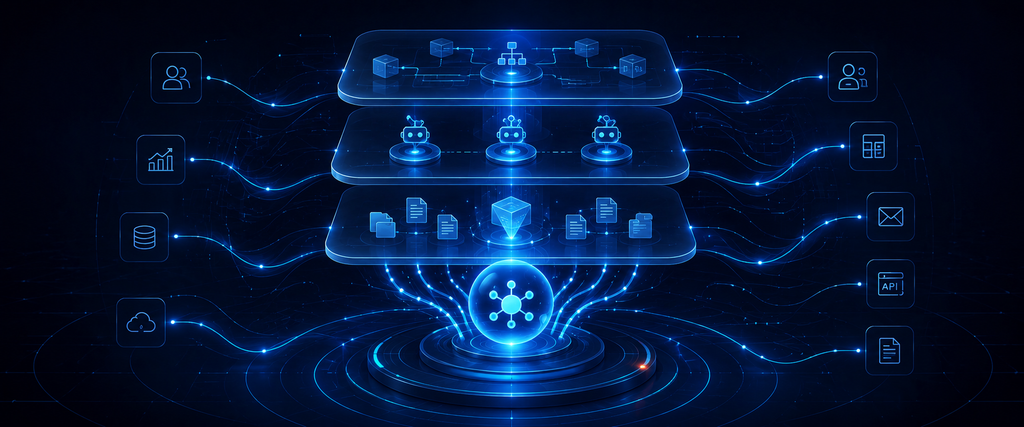
Intelligent Automation in 2026: The Complete Guide to RPA, AI Agents & Hyperautomation
Automation in 2026 demands orchestrating workflows, RPA, AI document understanding, and autonomous agents into one reliable system. Despite rapid market growth, many initiatives fail. This guide explains the automation stack, prioritization framework, and practical strategies for successful, scalable enterprise deployment today confidently.
Technodict11 min read- Hyperautomation
- Business Process Automation
- Finance Automation
- Agentic Automation
- Intelligent Automation
- Workflow Automation
- RPA
- AI Agents

OpenMontage + ComfyUI: Building a Self-Hosted AI Video Production Pipeline in 2026
Generative video models produce clips, not finished videos — the other 85% is orchestration. This guide shows how to connect OpenMontage's agentic production pipeline to a self-hosted ComfyUI backend: the adapter architecture, continuity engineering, VRAM realities, quality gates, and where self-hosting actually beats a commercial API.
Technodict17 min read- Intelligent Automation
- MLOps
- AI Agents
- Generative AI
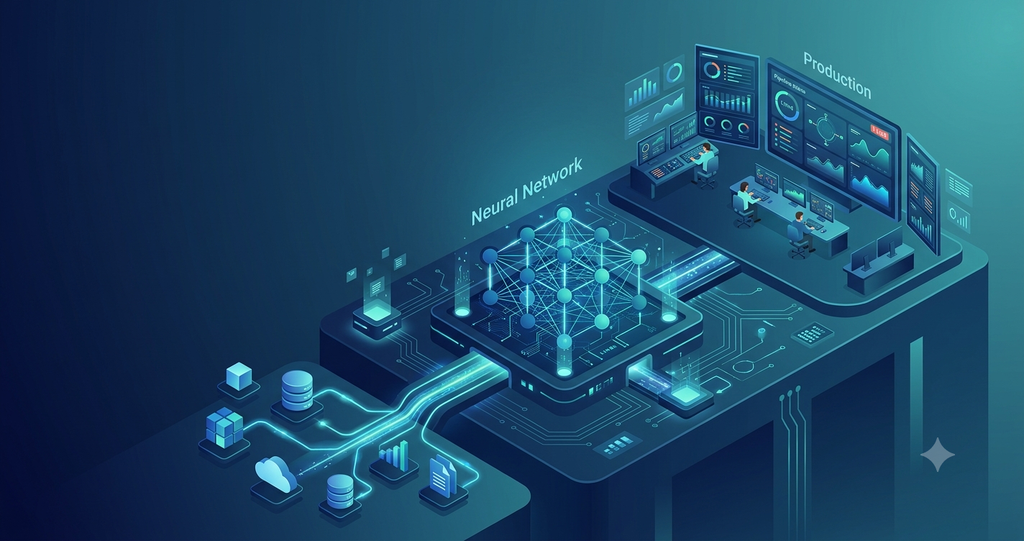
AI and Machine Learning in 2026: The Complete Enterprise Guide (From Strategy to Production)
Enterprise AI spending tripled to $37B in 2025, but pilots still outnumber production systems. This guide maps the journey from strategy to production: the AI/ML/deep-learning hierarchy, the six-stage ML lifecycle, build vs. buy, why projects stall, and where agentic AI is heading.
Technodict8 min read- Artificial-Intelligence
- MLOps
- AI Strategy
- Machine Learning
- Generative AI
- Agentic AI