
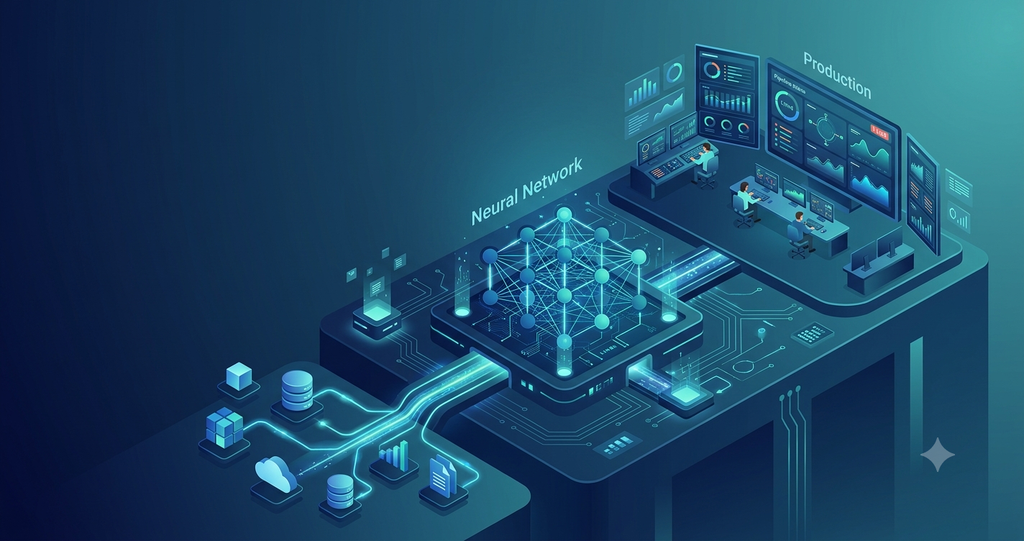
AI and Machine Learning in 2026: The Complete Enterprise Guide (From Strategy to Production)
 Technodict8 min read
- Machine Learning
- Generative AI
- Agentic AI
- AI Strategy
- Artificial-Intelligence
- MLOps
AI and Machine Learning in 2026: The Complete Enterprise Guide
AI vs. Machine Learning vs. Deep Learning
These terms are used interchangeably in boardrooms and incorrectly in most of them. The relationship is a set of nested circles.
Artificial Intelligence is the broadest field: any technique that lets machines perform tasks that normally require human intelligence. Machine Learning is the subset of AI where systems learn patterns from data rather than following hand-coded rules. Deep Learning is a subset of ML that uses many-layered neural networks, and it powers most of today's breakthroughs, including the large language models behind generative AI.
| Term | Scope | Example |
|---|---|---|
| Artificial Intelligence | Any machine intelligence | A rules-based fraud filter |
| Machine Learning | Learns from data | A model predicting churn from customer history |
| Deep Learning | Multi-layer neural networks | Image recognition, speech-to-text |
| Generative AI / LLMs | Deep learning that generates content | A model drafting a contract or writing code |
Why this matters for leaders: the governance, cost, and talent profile of a classical ML churn model is completely different from that of a generative AI assistant. Conflating them leads to mispriced projects and misplaced risk controls.
The State of the Market in 2026
The numbers explain the urgency.
- The global AI market was ~USD 390.91 billion in 2025 and is projected to hit USD 3,497.26 billion by 2033, a 30.6% CAGR. [Grand View Research]
- Enterprise generative AI spending reached USD 37 billion in 2025, a 3.2x jump from USD 11.5B in 2024. [Menlo Ventures]
- 76% of enterprises now buy AI solutions rather than build them, up from 53% a year earlier. [Menlo Ventures]
- North America held 35.5% of AI revenue in 2025, while Asia Pacific is the fastest-growing region. [Grand View Research]
Two signals stand out for strategy. First, the decisive shift toward buying and integrating rather than building from scratch means the scarce capability is no longer model training — it is integration, data engineering, and operations. Second, adoption is uneven: coding assistants alone accounted for roughly USD 4 billion of departmental spend, showing that value concentrates where the workflow is well-defined and measurable. [Menlo Ventures]
The Enterprise Machine Learning Lifecycle
Successful ML is a lifecycle, not a project with an end date. Treating it as the latter is the single most common structural mistake.
1. Problem framing and success metrics
Start from a business decision, not a dataset. Define the metric the model must move (reduce churn by X%, cut manual review time by Y hours) and the baseline. If you cannot state the metric and baseline, you are not ready to build.
2. Data foundation
Most ML effort is data effort: sourcing, cleaning, labeling, and building reliable pipelines. Fragmented data across systems and inconsistent quality are repeatedly cited as top obstacles. [Datategy] Invest here first; a mediocre model on great data beats a great model on poor data.
3. Model development
Choose the simplest approach that meets the metric. For structured prediction, gradient-boosted trees often beat deep learning. For language and unstructured data, evaluate whether an existing foundation model with RAG solves it before training anything custom.
4. Evaluation
Test against held-out data and, critically, against business impact — not just accuracy. Include fairness, robustness, and edge-case testing. For generative systems, build an evaluation harness with representative prompts and graded outputs.
5. Deployment
Ship behind an API or into the workflow where the decision is made. Containerize, version, and automate the release. This is where MLOps begins in earnest.
6. Monitoring and maintenance
Models decay. Model drift — when the world shifts away from the training data — silently erodes accuracy. Monitor inputs, outputs, and business metrics; set alerts; and plan retraining cadences. This ongoing operation is what separates a demo from a dependable system.
Expert perspective: As practitioners often put it, "a model that isn't monitored is a liability, not an asset." The production phase is where value is realized and where most of the total cost of ownership actually lives.
Implementation checklist
- [ ] Business metric and baseline defined
- [ ] Data pipeline reliable and documented
- [ ] Model beats a simple benchmark on business impact
- [ ] Evaluation covers fairness, robustness, edge cases
- [ ] CI/CD for models (versioning, rollback)
- [ ] Monitoring for drift, latency, cost
- [ ] Governance sign-off and audit trail
- [ ] Retraining and ownership plan assigned
Build vs. Buy: Making the Right Call
With 76% of enterprises buying, the default has flipped — but "buy" is not always right. Use this comparison as a starting point.
| Factor | Build (custom models) | Buy (APIs / platforms) |
|---|---|---|
| Time to value | Slow | Fast |
| Differentiation | High (if data is proprietary) | Low (everyone has access) |
| Upfront cost | High | Low |
| Ongoing cost | Predictable, infra-heavy | Usage-based, can scale unexpectedly |
| Talent needed | Deep ML team | Integration engineers |
| Best for | Core, defensible IP | Common tasks (coding, support, summarization) |
Advantages of buying: speed, lower upfront risk, access to frontier capability, and vendor-maintained improvements. Disadvantages: less differentiation, data-governance questions, and usage costs that can surprise you at scale.
Advantages of building: control, differentiation on proprietary data, and cost predictability at high volume. Disadvantages: talent scarcity, longer timelines, and full ownership of the maintenance burden.
A practical middle path most enterprises land on: buy the foundation model, build the differentiation around it — your data, your retrieval layer, your evaluation, your workflow integration.
Why ML Projects Stall (and How to Prevent It)
The pilot-to-production gap is real, and its causes are consistent. The most frequently cited enterprise obstacles are [Datategy]:
- Complex data management — massive, mixed, siloed data.
- Organizational silos — data science, DevOps, and operations not aligned.
- Regulatory compliance — GDPR, HIPAA, and now the EU AI Act.
- Cost optimization — training, inference, and scaling economics.
To these, add model drift, integration bottlenecks, and a lack of clear governance. [Datategy]
How to prevent stalls
- Design for production from day one. Decide deployment target, monitoring, and ownership before writing model code.
- Adopt MLOps early. Versioning, automated pipelines, and monitoring are not luxuries; they are what keeps models alive.
- Break the silos. Put data science, platform/DevOps, and the business owner on one team with one metric.
- Budget for the whole lifecycle. Most cost and risk appear after launch.
Common mistakes to avoid
- Optimizing accuracy while ignoring business impact.
- Shipping without monitoring ("fire and forget").
- Underestimating data and integration work.
- Choosing a complex model when a simple one would do.
- Treating compliance as an afterthought.
High-Value Use Cases by Industry
Value concentrates where workflows are well-defined and outcomes are measurable.
| Industry | Use case | Outcome |
|---|---|---|
| Healthcare | Clinical documentation ("scribes"), triage support | Less admin time; healthcare led AI revenue in 2025 [Grand View Research] |
| Finance | Fraud detection, credit risk, document processing | Lower losses, faster decisions |
| Retail / E-commerce | Demand forecasting, recommendations, dynamic pricing | Higher margin and conversion |
| Manufacturing | Predictive maintenance, quality inspection | Reduced downtime |
| Software / IT | Coding assistants, incident response | Largest single genAI spend category [Menlo Ventures] |
| Customer operations | Support copilots, deflection, summarization | Lower cost per contact |
Governance, Compliance, and Responsible AI
Governance has moved from afterthought to procurement gate. A workable enterprise framework covers: data privacy (GDPR, HIPAA), risk classification (aligned to the EU AI Act's tiers), transparency and documentation (model cards, data lineage), human oversight for high-stakes decisions, bias and fairness testing, and security (prompt-injection defenses, access controls, private inference). Bake these into the lifecycle rather than bolting them on; the audit trail you build during development is what lets you deploy in regulated contexts at all.
What's Next: Agentic AI and Small Language Models
Two shifts will shape 2026–2027.
Agentic AI moves beyond single-prompt chatbots to autonomous agents that plan and execute multi-step workflows using tools and APIs. The opportunity is large, but so is the reliability challenge — agents amplify both capability and failure modes, which makes evaluation and guardrails essential.
Small Language Models (SLMs) are increasingly the smart default for agentic workloads: cheaper, faster, and often good enough for narrow tasks, with frontier models reserved for the hard steps. Research argues SLMs are, in fact, "the future of agentic AI" for exactly these economic and latency reasons. [arXiv 2506.02153] For enterprises, this means a portfolio approach — a few frontier models plus many specialized small ones — rather than one model for everything.
Conclusion
The enterprises winning with AI in 2026 are not distinguished by louder ambitions or bigger pilots. They are distinguished by operational discipline: clear metrics, a solid data foundation, MLOps from day one, honest governance, and a build-vs-buy decision made deliberately rather than by default. The market is enormous and growing at over 30% a year, but the returns flow to organizations that can reliably ship and maintain models, not merely experiment with them. Treat AI as a lifecycle to operate, not a project to finish, and the technology will compound in your favor.
Frequently Asked Questions
AI is any machine intelligence; machine learning is AI that learns from data; deep learning is ML using multi-layer neural networks, which powers generative AI and LLMs. They are nested subsets, not synonyms.
The common causes are complex, siloed data; misaligned teams; compliance hurdles; cost overruns; and a lack of monitoring and governance. Most failures are operational, not algorithmic.
In 2025, 76% of enterprises bought rather than built. [Menlo Ventures] The pragmatic pattern is to buy the foundation model and build your differentiation — data, retrieval, evaluation, and workflow integration — around it.
MLOps is the discipline of deploying, versioning, monitoring, and maintaining models in production. If you plan to run ML beyond a one-off demo, yes — it's what keeps models accurate and accountable over time.
Model drift is accuracy decay as real-world data diverges from training data. Prevent it with input/output monitoring, business-metric alerts, and a scheduled retraining plan.
Agentic AI refers to systems that autonomously plan and execute multi-step tasks using tools and APIs, rather than responding to a single prompt. It's promising but demands strong evaluation and guardrails.
It varies widely, but budget for the full lifecycle — data engineering, development, deployment, and especially ongoing monitoring and retraining, where much of the total cost lives. Distinguish training cost from recurring inference cost.
Yes, when scoped to a measurable workflow. Mid-market firms often see the fastest ROI by buying capabilities and applying them to a well-defined process rather than building bespoke models.
Turn AI ambition into production outcomes
TechnoDict helps enterprises move from pilot to production — data foundations, MLOps, and responsible-AI governance included.
Related reading

OpenMontage + ComfyUI: Building a Self-Hosted AI Video Production Pipeline in 2026
Generative video models produce clips, not finished videos — the other 85% is orchestration. This guide shows how to connect OpenMontage's agentic production pipeline to a self-hosted ComfyUI backend: the adapter architecture, continuity engineering, VRAM realities, quality gates, and where self-hosting actually beats a commercial API.
Technodict17 min read- Intelligent Automation
- MLOps
- AI Agents
- Generative AI
AI Agents vs Traditional Automation: What Enterprises Should Adopt in 2026
Enterprises no longer ask "should we automate" — they ask "with what." Robotic process automation (RPA) built the last decade of back-office efficiency. AI agents are now promising to handle what RPA never could: judgment, exceptions, and unstructured work. But the two aren't interchangeable, and 2026 is the year most enterprises will have to decide, process by process, which paradigm belongs where — or how to run both together. This guide breaks down the real differences, where each wins, where they fail, and how to build a hybrid roadmap instead of betting the whole automation budget on hype.
Technodict10 min read- Agentic AI
- RPA
- Intelligent Automation
- AI Agents